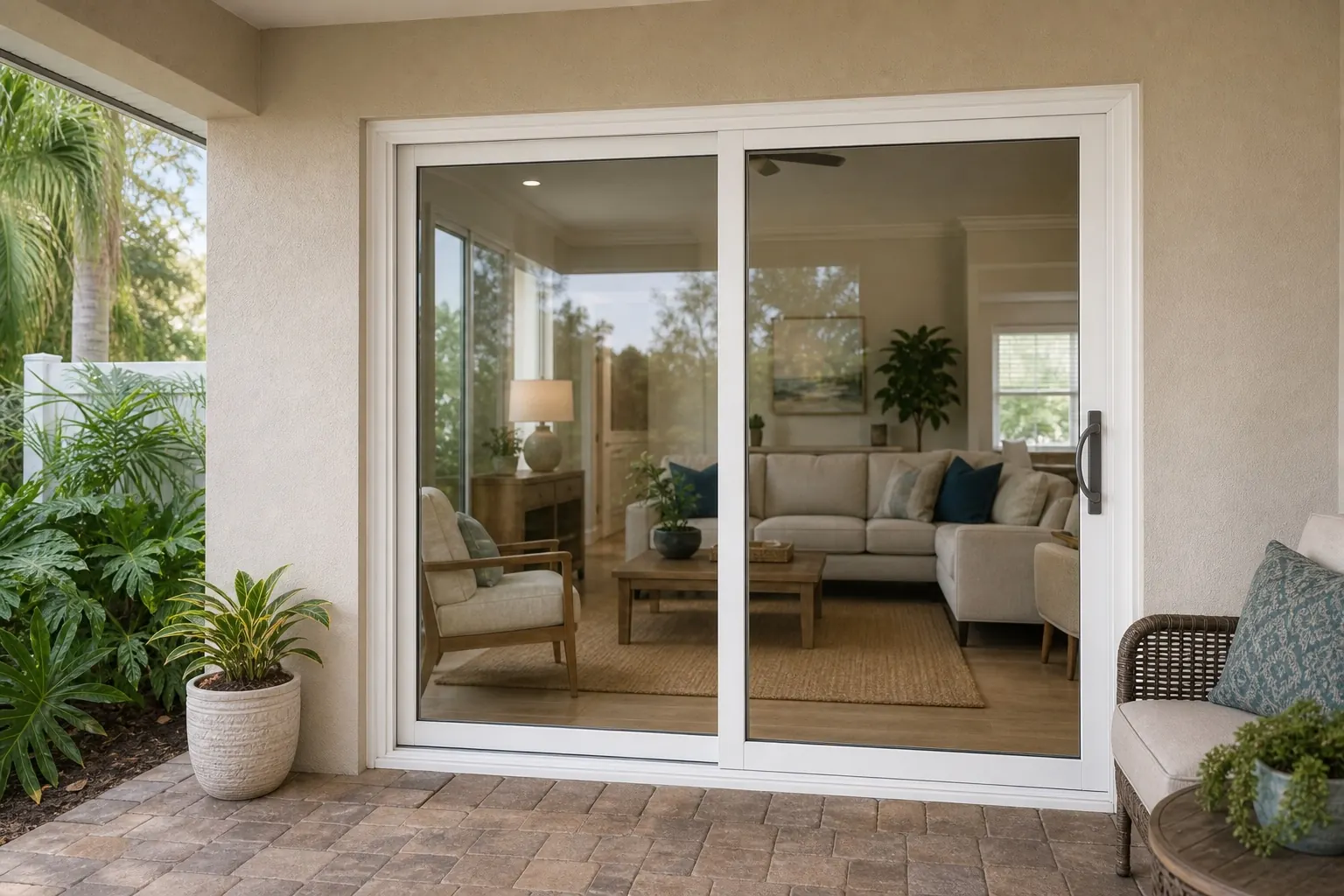
Your sliding glass door is one of the hardest-working openings in your home. It's opened and closed thousands of times a year, it carries more glass than almost any other opening, and it's expected to hold a tight seal against Florida's heat, humidity, and driving rain. When a slider starts to fail, the signs usually show up gradually, and they're easy to write off as "just getting old" until the energy bills or the water intrusion make them impossible to ignore.
The good news is that sliding glass doors, like windows, almost always warn you before they become a serious problem. Knowing what to look for helps you decide whether a simple adjustment will do, or whether it's time for a replacement that actually solves the issue.
Warning Signs Your Sliding Glass Door Needs to Be Replaced
Sticks or Drags on the Track
If the panel no longer glides smoothly after the track is cleaned, the rollers or track have usually worn out. Forcing a sticking door only accelerates the damage.
Difficulty Locking or Latching
A slider that won't lock cleanly has usually dropped on its rollers or shifted in the frame. On a patio door, that's both a comfort issue and a real security concern.
Fogging Between the Glass Panes
Condensation or haze inside the glass means the insulated seal has failed. It can't be cleaned or repaired, the glass unit, and often the door, needs replacing.
Higher Energy Bills
A large expanse of single-pane or failed glass lets conditioned air escape and radiant heat pour in. A slider is often the single biggest source of heat gain in the room.
Drafts or Daylight at the Frame
Feel for air movement along the meeting rail and edges on a windy day, or look for daylight around a closed panel. Both point to worn weatherstripping or a shifted frame.
Water or Corrosion at the Track
Standing water, rust, or pitting in the sill track means the weep drainage is clogged or the track is corroding, a direct path to frame rot if it isn't addressed.
The Florida Factor: Why Sliding Doors Wear Out Faster Here
Central Florida's climate is especially hard on sliding glass doors, that big glass area and the exposed sill track take the brunt of it. Three forces are primarily responsible:
Humidity Cycling
Humidity here routinely swings between 40% and 95% through the year. That constant moisture load degrades weatherstripping and seals, and, combined with salt-laden air near the coast, corrodes rollers, tracks, and locking hardware far faster than in drier climates. It isn't what breaks an insulated-glass seal in the first place, that's mostly the daily heat and pressure cycling working on the sealant, along with UV. But humidity is what makes the failure show: once the seal is compromised, moist air gets pulled in, and that's the "fogging" you see between the panes.
UV Exposure
The desert Southwest gets more raw solar energy than Florida does, but Florida's low latitude gives it some of the highest UV levels in the country, and it gets them for far more of the year than anywhere north of here. A sliding door presents a large, unshaded target for all of it. South- and west-facing sliders take particularly intense UV that breaks down weatherstripping and gaskets and stresses the glass seal over time. Low-E coated, dual-pane glass holds up far better and keeps the room from turning into a greenhouse.
Hurricane Season Stress
Even storms that don't make direct landfall bring long stretches of wind-driven rain, the single best way to expose hidden gaps. Water works its way through the track and meeting rail long before air infiltration is obvious. If you find water pooling inside at the track after a heavy storm, treat it as an urgent signal: moisture in the rough opening spreads rot into the surrounding wall.
Repair or Replace? A Practical Guide
Colonial installs replacement sliding glass doors; we do not provide repair service or sell doors without installation. The repair suggestions below are general homeowner guidance. If repair is the right next step, contact a sliding-door repair specialist.
| What You're Seeing | Repair | Replace |
|---|---|---|
| Sticks slightly, track just needs cleaning | ✓ Clean & lubricate first | |
| Worn or compressed weatherstripping | ✓ Repair first | |
| Panel drags on worn rollers | ✓ Replace rollers first | |
| Minor surface scratches on the frame | ✓ Touch-up | |
| Fogging or condensation between the glass | Replace, seal has failed | |
| Bent, corroded, or pitted track | Replace, won't glide reliably | |
| Daylight or drafts around a closed panel | Replace if frame has shifted | |
| Lock won't engage due to frame movement | Replace, security risk | |
| Water intrusion at the sill or track | Replace and inspect rough opening | |
| Slider is 20+ years old, pre-2002 code | Consider proactive replacement |
What to Look for in a Replacement Sliding Door
Because so much of a sliding door is glass, the glass package is the biggest factor in comfort and energy use. For Florida homes, prioritize Low-E, argon-filled dual-pane glass, it's the single biggest factor in comfort and energy use, and on a door this size the payoff is even larger. It's the same glass technology that matters in replacement windows.
Beyond the glass, look for a multi-point locking system, heavy-duty stainless steel rollers rated for the weight of the panel, and corrosion-resistant tracks that stand up to Florida's humid, salt-tinged air. A quality slider also includes a proper sill with working weep drainage and adjustable weatherstripping that keeps its seal even after the house settles.
Installation matters as much as the door itself. A sliding door set without proper flashing, a sill pan, and a continuous moisture barrier will leak at the track long before the panel ever wears out. Always use an installer who treats the rough opening, not just the visible frame, as part of the job.
Considering a Replacement Sliding Door?
Colonial can evaluate the opening, discuss replacement options, and provide an estimate for professional installation. We do not offer repair service or product-only sales.
Request an Installation EstimateHow a New Sliding Door Affects Your Home Value
We'll be careful here, because this is a place where contractors tend to quote numbers they can't back up. The industry's Cost vs. Value report doesn't track sliding patio doors as their own category, so anyone citing a precise payback percentage for a slider is guessing. What the report does show consistently is that exterior replacements dominate the highest-returning projects, with vinyl window replacement recouping roughly two thirds to three quarters of its cost at resale. A slider is the same kind of improvement: exterior, visible, and obviously either maintained or not.
What we can say without hedging is that a tired slider is conspicuous. Unlike most improvements it's visible from both inside and out, and a clean, modern one reads as "well cared for" to buyers the moment they walk into the room.
The day-to-day improvement is just as real. A door that glides with one finger, locks securely, and stays clear instead of fogging turns a patio from an afterthought into an everyday extension of your living space, with a wall of natural light to match.
If you're planning to sell within a few years, a new slider recovers part of its cost at resale while making the home more comfortable in the meantime. If you're staying put, the energy savings and the added security of a modern multi-point lock are usually the better reason to do it, and they don't depend on what a buyer eventually thinks.